On Thursday evening one of us sat in the audience at GSEC Málaga, Google’s cybersecurity centre on Paseo de la Farola, for the October session of the Malaga-AI community. There were two talks. Alexis Sánchez, a developer, gave a survival guide for people who write code. Manuel Villarejo, a technology leader who runs operating-model transformations, argued that AI transformation is ordinary change management on a faster clock.
One talk was about a single engineer and a ticket, the other about whole organisations. They ended in the same place. In both, the AI asks the questions, a written contract or spec comes first, and people keep the gates.
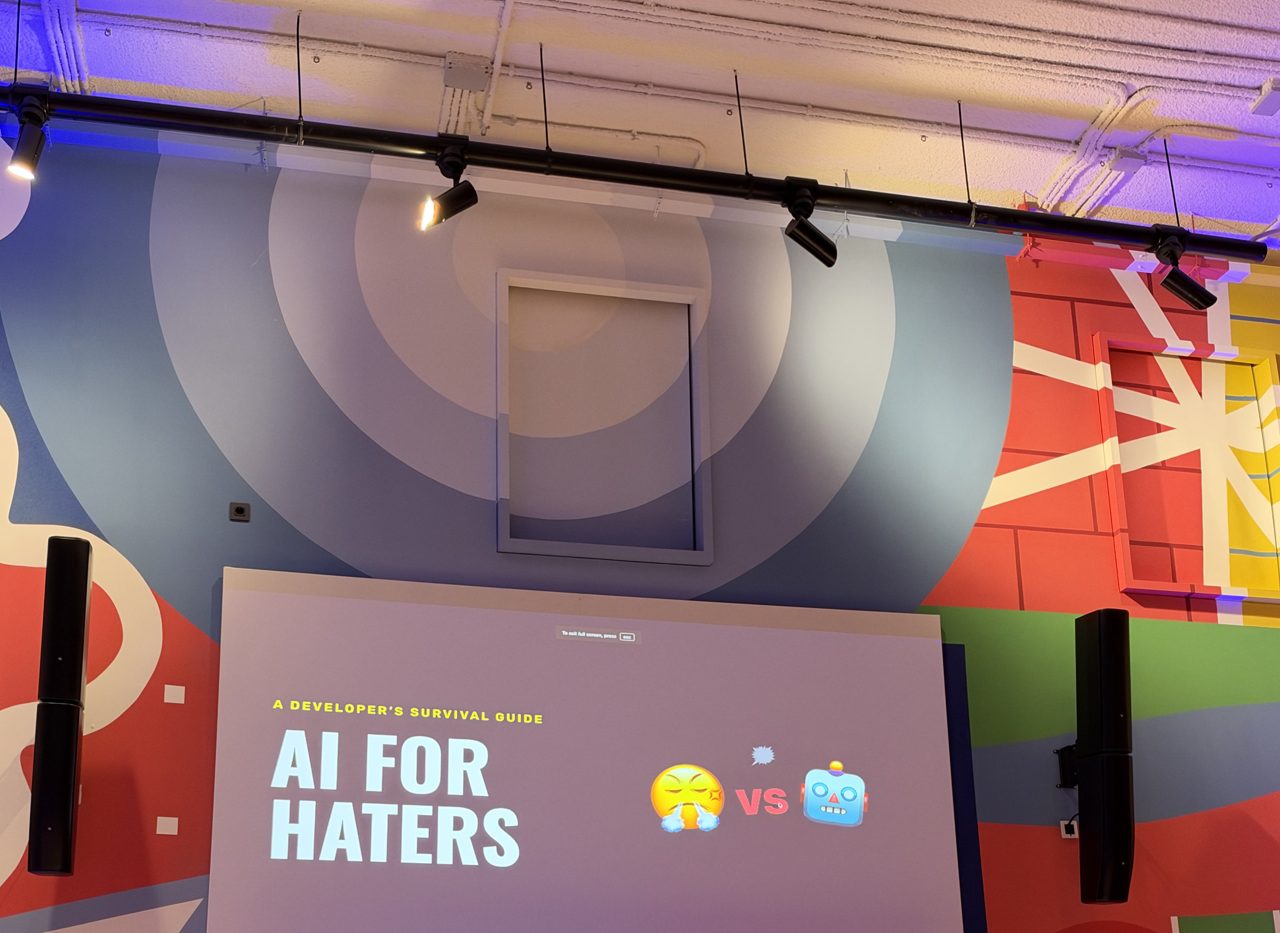
GSEC Málaga, 29 October. First talk up.
Alexis Sánchez opened with a confession. I love coding. Apparently, that’s controversial now. He spoke as a working developer who had started to wonder whether the job itself was disappearing. His talk, AI for Haters: A Developer’s Survival Guide, ran in three acts, and the first was about losing the part of the job he liked.
His typical day had become, in his slide’s words, “professional AI chatter”. Another slide showed him as a middleman between a ticket and an AI: the ticket on one side, a Claude terminal on the other, Ctrl+V in between. The count underneath read: tickets “done” today, 2; lines I wrote, 0. The loop was asking, waiting, reviewing, asking again. A battery icon put developer joy at 16%. Then came the line the talk is named for. I started hating AI. Not because it didn’t work. Because it worked. He asked whether AI would replace him someday, and then a sharper question: had he already started replacing himself?
The turn was a change of diagnosis. Maybe the problem wasn’t AI. It was the relationship. Under “How it should work”, his slide put two labels side by side. The person is the Engineer. The AI is the Prompter. The roles are swapped, so the model asks and the engineer decides. The next slide put the same idea as a film. What if he was supposed to be Tony Stark, with AI as my JARVIS — not as the engineer?
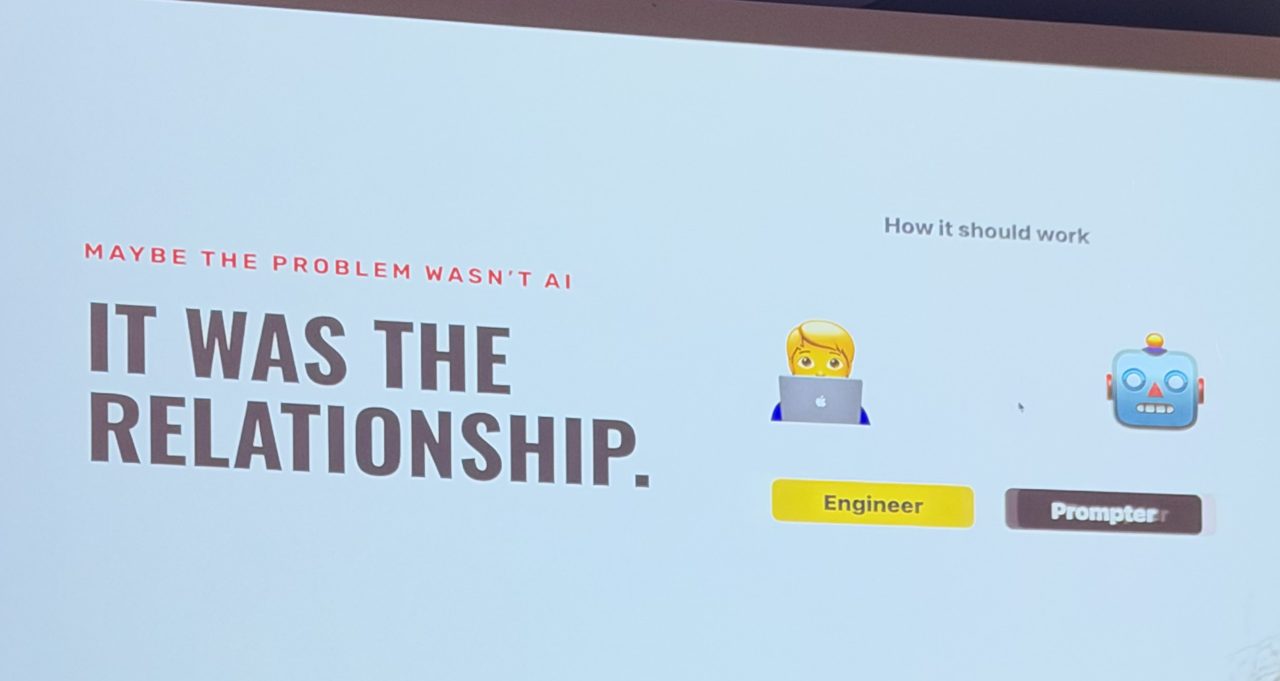
Alexis’s diagnosis: the roles were the wrong way round.
The second act was the case for keeping a person in the loop. It opened on a function with a hard-coded 37-millisecond sleep for one provider, marked DO NOT TOUCH, and git blame pointing at you, in 2019, after incident #4471 at 03:12 in the morning. The reason for that line lives in nobody’s prompt. His slide for it said a context window is not a career, and the window on it was full of the CTO’s mood, 3 AM lessons, “that 2021 decision”, customer rage and incidents. Then came a green build, 214 of 214 tests passing, with a small fire beside it. A robot wrote the code and a robot wrote the tests, so the test that passes is expect(bug).toBe(bug). Green tests ≠ correct system. The question he put next was when it fails: under load, offline, twice, halfway.
He took his model for the fix from a factory. A slide recapped a 2014 report on Toyota putting humans back where robots had worked, with the goal of workers who understand the process and design better automation. It credited the idea to Mitsuru Kawai: craftsmanship, meaning people who can spot what the machine gets wrong. Two lines followed from it. Don’t automate a bad process. It just fails faster. And if we automate away every chance to learn, who improves the automation tomorrow?
The third act took its title from the film: Be Tony Stark. Build your Jarvis. It started with a requirement, not code. First, define success. AI can help you ask the questions too. Around the title floated the questions a refund feature has to answer: partial refunds, duplicate requests, a client that disconnects, a database that fails, the invariants, what gets audited. The “before” slide was Prompt and pray, with three fires and “Prod is down”. The “after” slide was Engineering with AI. Define the contract first. The contract had five lines. Refunded is never more than paid. There is an idempotency key. It is concurrency-safe, safe to retry and fully auditable.
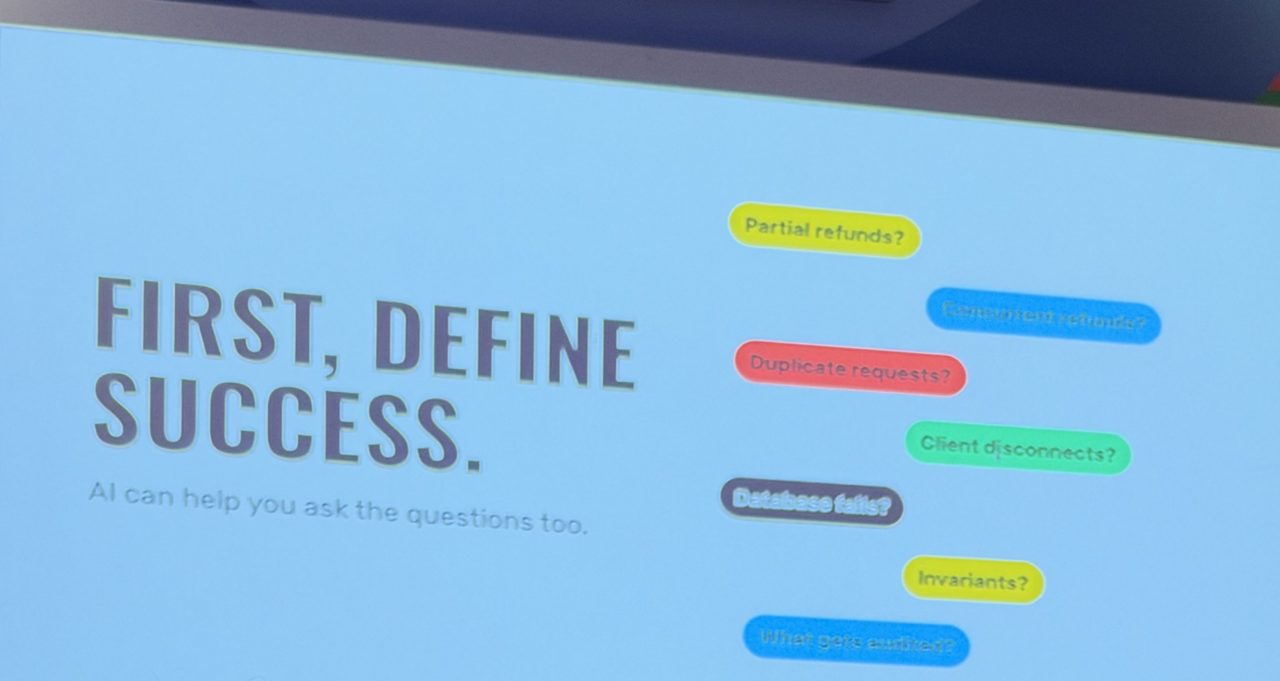
Before any code, the questions. Some of them come from the AI.
His survival guide had five steps: learn the fundamentals, always ask why, understand then automate, build your taste, and own the outcome. Customers, another slide said, don’t care who wrote the code, whether a human, an agent or a golden retriever. Fifty years of good practice still win, from tests and code review to refactoring, Big O and continuous integration. His last slides came back to where he started. I still love coding. Don’t outsource your understanding: delegate the work, keep the brain.
Manuel Villarejo’s title stated his argument: AI Transformation: Same Rules, Faster Clock, subtitled what 30-year-old change theory still gets right about AI transformation. His bio slide listed more than 20 years in technology, operating-model transformations of teams, processes and roles, and AI adoption led across several business functions. His thesis slide said it plainly. AI transformation is not different to traditional transformation just on a faster clock. Same principles. Same common mistakes. New pace.
He started with people, because people decide whether a change sticks. His slide split any group into four roles: 20% resisters, 60% bystanders, 10% helpers and 10% champions. Then he mapped them by influence. Resisters with influence get a one-to-one meeting, where the objection is heard and whatever is real in it gets fixed. Bystanders with influence get a seat where the standards are set. He marked both as critical. The 60% in the middle decide the outcome, and his take-home slide put it in three words: win the bystanders.
The next slide was about why people resist. People don’t resist the change… they resist what it costs them. He listed five costs: relationships, competence, identity, rewards and power. Two were marked as hit hardest by AI, competence and identity. That is the loss Alexis had described from the inside, the craft that defined him being done by something else. Manuel’s advice was to name the costs before you sell the benefits.
Then processes. In a typical software team the work goes from product to design to engineering to QA to DevOps, which makes four handovers. Every handover is a queue. Cut the ones you can. Each handover costs accountability, because nobody owns the result from start to finish. It costs focus, because every team juggles several queues. It costs detail, because each boundary needs a brief, a meeting and a ticket. His answer, citing the 2025 second edition of Team Topologies by Skelton and Pais, came with the picture people talked about afterwards. A few big ships give way to many small boats: many small, effective teams of product builders, each working from its own product spec, with clear review points where the work stays put.
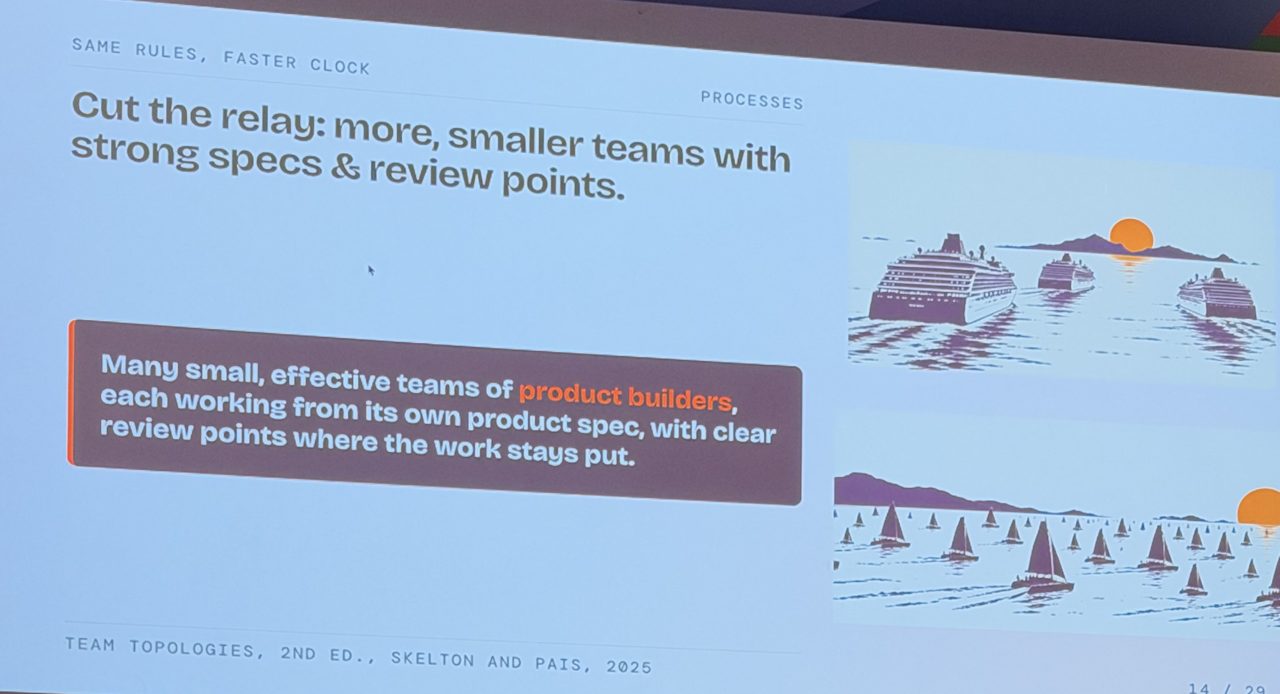
Fewer handovers: many small boats instead of a few big ships.
For tools, he recommended adopting a spec-driven method rather than inventing one. You write the spec in plain words, the AI drafts and a human signs off, and every change is a small delta so the review starts from what changed. His first pick was Matt Pocock’s Grill Me, in which the AI interviews you about your plan, one question at a time, until every branch is resolved. It works for plans that aren’t code. For people outside tech he gave the same method with a different spec: focus on the process, document everything you can, set the human quality gates, and let the AI choose the how. You own the what and the gates. AI proposes the how.
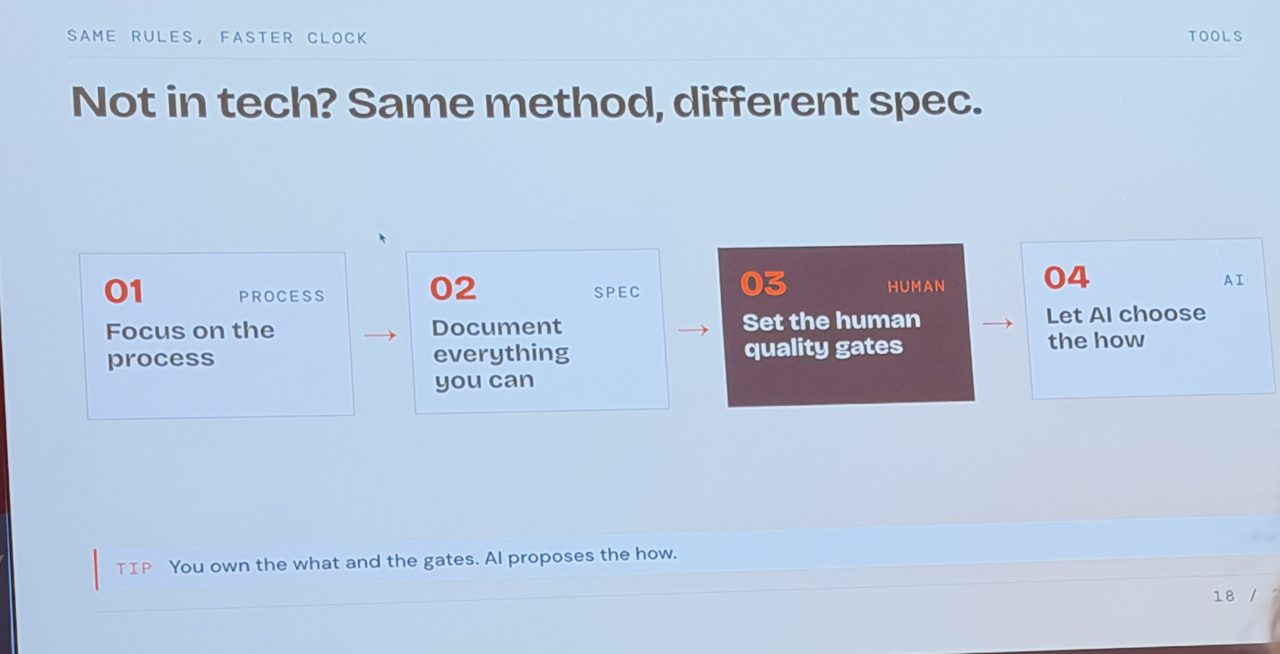
The step in the dark box is the one that stays human.
The plan came from 1995. John Kotter’s Harvard Business Review article Leading Change: Why Transformation Efforts Fail lists eight ways plans fail, from no sense of urgency to a change that never anchors in the culture. Manuel ran them as four steps. First, show why business as usual can’t go on; his example was a post by Sam Altman in March thanking the people who wrote extremely complex software character by character. Second, pick a core team with a senior sponsor who backs the change in public, with budget, time and decisions, not a kickoff email. Third, share a vision you can explain in five minutes and repeat everywhere. Fourth, act, reward the new way, and review every month. His last take-home went back further, to Kurt Lewin’s 1947 model of unfreeze, change and refreeze. Manuel’s version was never freeze.
After the talk one of us asked him how the relay would compress. With product, engineering, QA and DevOps, would it come down to a product person and an engineer? He thought teams of three were about right. His first step for anyone in such a team is to build an agent of yourself, a shadow that does what you do, and then step back. After that you learn what sits upstream and downstream of you. For an engineer, that means how requirements are made and how QA is done.
Put the two talks side by side and they make the same three moves.
The AI asks the questions. Alexis labelled the AI as the prompter and had it list what a refund has to survive. Manuel’s first tool is an AI that interviews you about your plan until every branch is resolved.
The contract comes first. Alexis’s “after” slide was a five-line contract written before any code. Manuel’s first step was the spec in plain words, and his tip was to write the need before the code.
People keep the gates. Alexis ended on owning the outcome and not outsourcing your understanding. Manuel put the human quality gates in the one dark box on his slide.
This site works the same way. Every experiment in our public log, Chronos, starts with a hypothesis written down before the run. In our pipelines, code does what can be checked, and a model fills in only what can’t. Alexis’s green build is the failure that habit is there to catch. At last month’s Malaga-AI showcase, three of the four talks used one AI to grade another, and one of them measured how far the grade moved when the grader changed. A robot that writes both the code and the tests is the same problem inside a single pull request.
Thanks to Alexis and Manuel, and to the Malaga-AI organisers and GSEC for the room. Malaga-AI is at malaga-ai.community and on Discord.
Talks as presented on 29 October 2026 at GSEC Málaga, in English. Slide text is transcribed from photographs taken from the audience and cropped to the screen; where it differs from the speakers’ own decks, the decks are right. Both speakers agreed to this write-up.